

On April 1, 2026, the general office of the Ministry of Industry and Information Technology (MIIT), joined with other 4 national ministries of China, issued the Guidelines on Green Design of Industrial Products (2026 version) (hereinafter referred to as “the Guidelines”).
The legal basis of the Guideline is the Action Plan for Green and Low-Carbon Development in Manufacturing (2025–2027) which was approved by the State Council of China in May of 2025. In the Guideline, “green design” is defined as: a design concept and methodology that focuses on sustainability, aiming to reduce or control resource consumption and environmental impact throughout the product's lifecycle from the initial design stage, and is also known as “ecodesign”. It is also clearly stated that this document is formulated in order to better guide green design of industrial products, promote green manufacturing, and strengthen coordinated efforts to reduce carbon emissions, pollution, and expand green growth, achieving low-carbon and sustainable development.
The Guidelines consist of 4 chapters, and the main contents include:
- In accordance with the product lifecycle concept, define the connotation and requirements of green design; focus on 11 key perspectives (see figure) for green design solutions tailored to the needs of 15 critical sectors (automotive, construction machinery, machine tools, bearings, wind power equipment, hydrogen energy equipment, photovoltaics, lithium batteries, household appliances, packaging, detergents, textiles, biomanufacturing, methanol, tyres).
- Summarize 11 green design strategies (see figure) and their core contents, providing more specific technical recommendations within the guidelines.
- Propose implementation measures from different angles, such as developing green design solutions, advancing "artificial intelligence + green design," establishing green design standards, promoting landmark green design products, strengthening talent development in green design, and deepening international exchange and cooperation etc.
- Fully leverage the roles of different interested parties including but not limited to local industrial and information technology departments, ecological and environmental authorities, market supervision regulators, sector associations, universities, research institutes, and enterprises, to actively engaging in policy guidance, standard development, promotion and training, and product innovation related to green design.
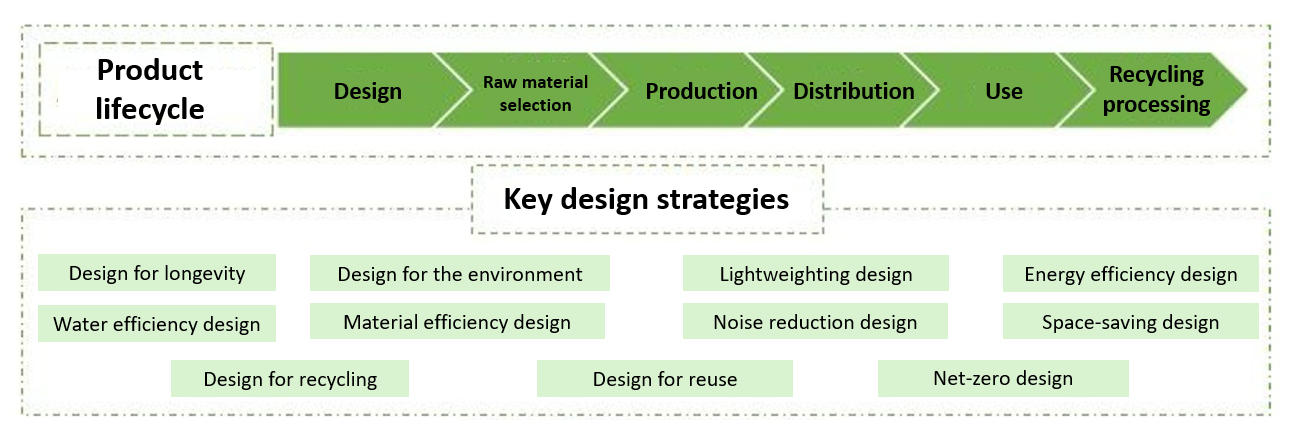
Figure – Structure of Green Design System of Industrial Products
Specifically for standardization work, the Guidelines point out that:
Strengthen standard guidance and establish a "1+N" green design standard system.
Formulate national standard on general principles for green design of industrial products to guide product designers and developers in green design practices.
Tailor green design requirements, key priorities, and implementation pathways to the specific characteristics and needs of different sectors, and research and develop sector-specific green design standards.
Actively participate in the development and revision of international standards related to green design.
For foreign stakeholders, China’s national-level efforts on green/ecodesign began in the year od 2013 by issuing the Guiding Opinions on Promoting Eco-Design for Industrial Products. The publication of the Guidelines is another key point to indicate the country’s determination on green development, and to a bigger picture, achieving the carbon peaking in 2030 and carbon neutrality goals in 2060. It is advised to notice and keep up with the future progress on standard system, sector-specific policy or regulation etc. in order to ensure product compliance. For the interested parties whose business falls within the 15 sectors that are listed in the Annex II of the document with detailed green design suggestions, it is advised to review the design guideline and make necessary adjustment if any may potentially lead to market access risks.


Top Read Articles
Switch articles-
 2026.06.29
CCC Implementation Rules of China Will Issue English Version – JUN, 2026
-
 2026.06.17
Draft Reveals New Chemical Substance Registration Rules of China – JUN, 2026
-
 2026.06.15
Several Chinese Entities Confirmed for International Standardization Responsibilities – JUN, 2026
-
 2026.06.10
China RoHS Updated the Management Catalogue and Exemption List – MAY, 2026
-
 2026.06.08
New Standards Issued with Stricter Requirements for Automotive Products in China – MAY, 2026